
Lawn Maintenance vs. Lawn Care: Which Does Your NJ Property Need?
Lawn maintenance is the routine upkeep that keeps a property tidy: mowing, cleanups, bed weeding, and mulch. Lawn care is the turf health program: fertilizing, weed control, aeration, and overseeding. Most South Jersey properties benefit from both, since mowing alone won’t fix thin turf and a feeding program won’t keep beds tidy.
What is the difference between lawn maintenance and lawn care?
Maintenance is about how the property looks week to week. Lawn care is about how healthy the grass is underneath. They overlap on the same lawn, but they are different jobs, done with different equipment, on different schedules.
Maintenance is recurring and visible. Someone cuts the grass, clears debris, keeps weeds out of the beds, and refreshes mulch and flowers. Lawn care is more like a treatment plan. It happens a few times a year, it is timed to the grass’s growth cycle, and the results show up over weeks or months rather than the same afternoon.
Here is the comparison side by side:
- Landscape maintenance: The goal is a neat, tidy property. Typical tasks are mowing, cleanups, bed weeding, mulch, and annual flowers. Visits are regular during the season, and you see results right after each one.
- Lawn care: The goal is thick, healthy turf. Typical tasks are fertilizing, weed control, aeration, and overseeding. Timing follows the season, and results build over weeks and months.
If the question is "does it look cared for today," that is maintenance. If the question is "will this lawn be thicker next year," that is lawn care.
What does a landscape maintenance visit usually include in New Jersey?
For us, landscape maintenance covers lawn mowing, spring cleanups, fall cleanups and leaf removal, weed control in landscape beds, mulch and rock installations, and annual flower displays. It is the work that keeps a property from slipping between bigger projects.
A few details a local crew pays attention to:
- Mowing height and frequency. Many South Jersey lawns are cool-season grasses. Cutting too short in summer stresses them and lets weeds in. Growth also slows in heat and picks up again in fall, so a good schedule is not the same all year.
- Spring cleanups. Winter leaves the beds with matted debris, fallen branches, and old growth. Clearing it early lets beds dry out and makes the first mowing cleaner.
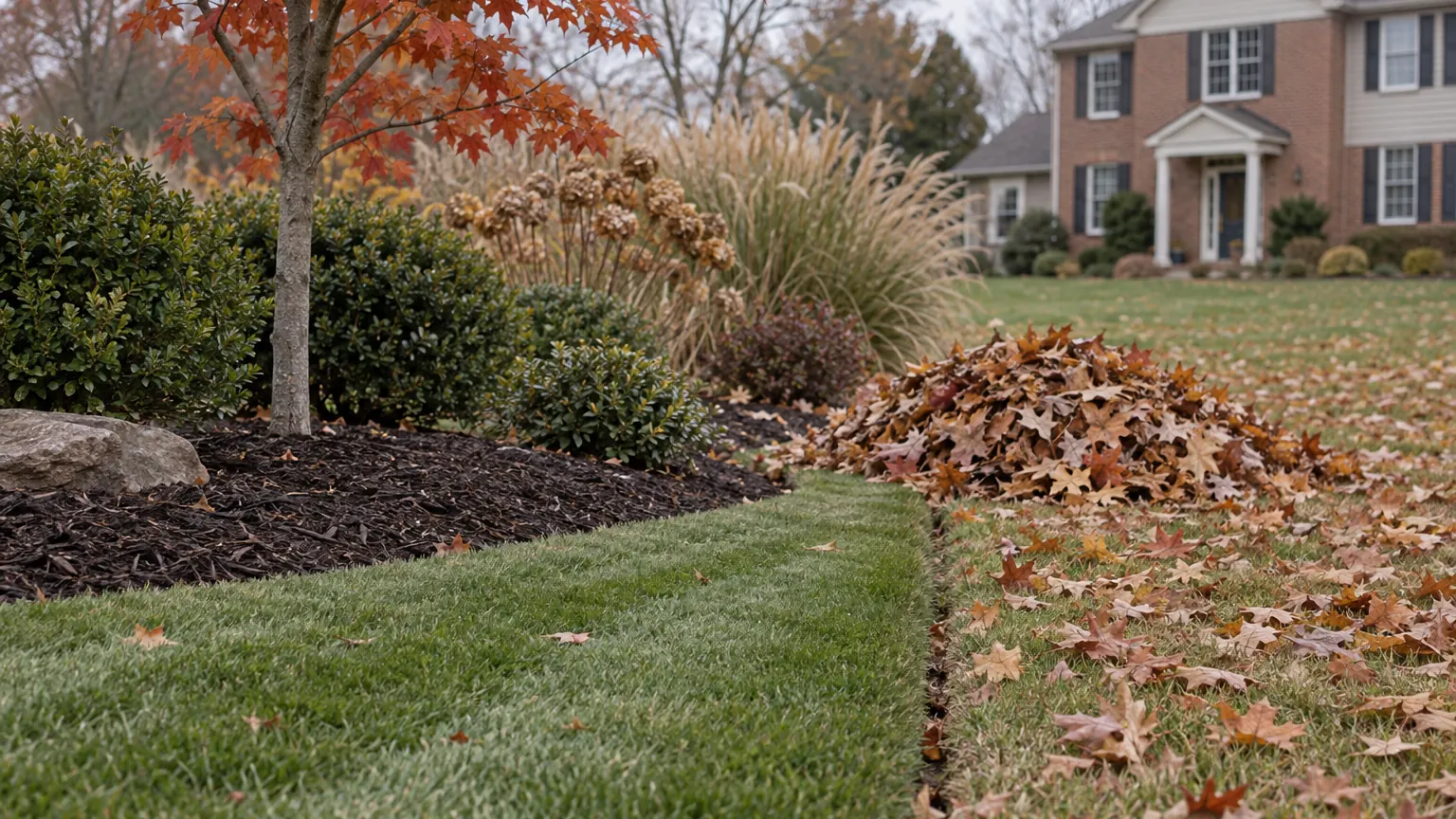
- Fall cleanups and leaf removal. Heavy leaf cover left on turf can smother the grass over winter. Removing it also keeps beds and the areas near the house clean.
- Bed weed control and mulch. Weeds in beds are a separate problem from weeds in turf. Mulch refreshed at the right depth slows them down and holds moisture around plantings.
- Annual flowers. These add color at entrances and focal beds and are usually swapped by season.
What does a lawn care program cover, and how is it different from mowing?
Mowing trims the top of the grass. Lawn care works on the grass plant and the soil. Our lawn care service includes lawn fertilization, weed control, core aeration, overseeding, and dethatching, along with lawn disease treatment and lawn insect control. We also handle hydroseeding and new lawn seeding for bare or new areas, and pest services like mosquito control, perimeter pest control, and flea and tick control.
Here is why the distinction matters in practice:
- Fertilization feeds the turf on a schedule suited to cool-season grass. New Jersey has rules on lawn fertilizer use, so check with the state or your township if you are doing it yourself.
- Weed control targets weeds growing in the lawn. Timing matters, because spring crabgrass prevention has to go down before the weed germinates.
- Core aeration pulls small plugs from the soil so water, air, and nutrients reach the roots. It helps most on compacted ground, which is common around newer homes where heavy equipment ran over the soil during construction.
- Overseeding adds new grass to thin areas. For cool-season lawns in this region, early fall is generally a strong window because soil is still warm and the air is cooling.
- Dethatching removes the layer of dead material that can build up between the grass and soil when it gets thick enough to block water.
None of that happens during a standard mowing visit. Good mowing habits can help turf fill in, but mowing alone may not fix thinning caused by compaction, low nutrients, disease, insects, or other underlying problems. Those usually call for a turf program.
Do South Jersey lawns need both services, or can you choose one?
You can choose one, but it helps to know what you are giving up.
Maintenance only works if your lawn is already thick and healthy and you mostly want a clean, regularly kept property. It is also common for properties where the turf is secondary to beds, entrances, and curb appeal.
Lawn care only fits homeowners who enjoy mowing and want help with the technical side, like feeding, weed control, aeration, and seeding.
Both makes sense when the lawn is a priority and you want it to look good and actually improve. For HOAs and commercial properties, the combination is usually the practical choice. Common areas, entrances, and storefronts get judged on both neatness and turf condition, and a thin, weedy lawn undercuts a freshly mowed one. We work with residential, commercial, and HOA properties, and the mix of services is usually what changes between them, not the basic approach.
A quick self-check: walk the lawn. Bare patches, lots of weeds, a spongy layer of thatch, or ground that is hard to push a screwdriver into all point to lawn care needs. Overgrown beds, bare mulch, and leaf piles point to maintenance needs.
How do the two services change through the New Jersey seasons?
Here is how a typical year breaks down for a cool-season lawn in South Jersey:
- Early spring: spring cleanup, first mowing, and crabgrass prevention timing. This is also a good time to assess how the lawn came through winter.
- Late spring: regular mowing, mulch installation in beds, bed weed control, and annual flower planting. Fertilization and broadleaf weed control fit here too.
- Summer: mowing a bit higher, keeping up with bed weeds, and watching for disease and insect problems. Heat and humidity here make fungal issues a real possibility, and grubs and other insects can damage turf.
- Early fall: core aeration and overseeding are the main events. For many thin cool-season lawns this is a prime time for repair, though the right plan depends on what is causing the thinning.
- Late fall: leaf removal and a final cleanup. Mowing winds down as growth stops.
Winter is quiet for turf. Commercial properties often shift attention to snow plowing, snow removal, and deicing, which we offer as commercial snow services.
How do you set up service for next year, whether you’re a homeowner or an HOA?
Late fall is a good time to plan, because the growing season is winding down and you can still see what worked and what did not. Start with a short list:
- Note where the lawn was thin, weedy, or compacted this year.
- Note which beds were hard to keep up with.
- Decide whether you want mowing and cleanups, a turf health program, or both.
- For an HOA or commercial property, list every area involved, such as entrances, common lawns, beds, and parking-lot edges, so the scope is clear.
- Ask for the schedule in writing, including what is and is not included in each visit.
The last point matters most. Basic mowing packages often leave out things like bed weeding, mulch, cleanups, and anything related to the turf itself. Knowing that up front prevents the "I thought that was covered" conversation in June.
If you want help sorting out which mix fits your property, you can reach out through our contact page and tell us about the lawn and beds. We serve Franklinville and surrounding South Jersey communities in Gloucester and Camden counties.
Frequently asked questions
Is mowing considered lawn care or lawn maintenance?
Mowing is generally part of lawn maintenance, the routine upkeep of a property. Lawn care usually refers to the turf health work like fertilizing, weed control, aeration, and overseeding. Some companies use the terms loosely, so ask what a quote actually includes.
Can one company handle both maintenance and lawn care?
Yes. We offer landscape maintenance (mowing, cleanups, bed weed control, mulch, and annual flowers) and lawn care (fertilization, weed control, aeration, and overseeding) as separate services. Having one company handle both can make scheduling simpler, especially for HOAs and commercial properties.
When should I lock in a maintenance schedule for next season in NJ?
Late fall and winter are good times to plan, before the spring rush. Spring cleanups and first mowings come early, and fall aeration and overseeding need to be planned well ahead. Setting expectations early also gives you time to compare scopes.
Do HOAs and commercial properties need a different service mix than homeowners?
Often, yes. Shared areas usually have more square footage, more beds, and higher visibility, so the scope tends to include regular mowing, cleanups, bed care, and a turf program. Commercial properties may also want snow services in winter. A written list of every area covered keeps things clear.
What is usually left out of a basic mowing service?
Basic mowing typically does not include bed weeding, mulch, spring or fall cleanups, leaf removal, or any turf treatments like fertilizer, aeration, or overseeding. Check the scope before assuming those are covered.


